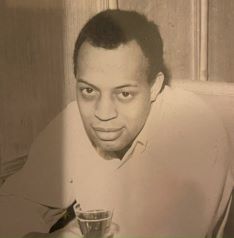
My father could not be said to have a way with words…or people. But strangely, he was one of few people in my life that seemed to understand the whole writing thing. Now, we didn’t have great or meaningful conversations. As a child, I felt neglected by him. In fact today, I can often be heard complaining to my own children, “my father never did anything with me…never taught me how to throw a baseball, never told me a bedtime story, or sang his favorite song,” etcetera, etcetera. This is all true. But he would often conclude our brief, stilted interactions by saying “keep writing.”
I didn’t wonder why at first. I assumed, since he was a practical man, that he thought it would be a solid vocation. But my father was not a fool, so I’m pretty sure this assumption was wrong.
When I was grown and well into my career of, well…NOT writing, he would still encourage it. The last significant amount of time I spent with him was in 2016. This was well after his mobility had been decreased by a stroke. In one of the few times he spoke, he asked me if I was still writing. At the time I was not. Oh, I would sit from time to time and fuss with old pieces or type out a beginning—and just a beginning. But I had functionally given up, whether I recognized it or not. I considered lying to him and saying “yes” because that would have ended the conversation quicker.
The reason why I didn’t is… well, this was immediately after the election. The election and Veteran’s Day made it a three day week so we decided to go to Florida after voting in our home state of Rhode Island. I told myself, my wife, my kids, and others repeatedly in those days after the election, everything is going to be fine. Or, at the very least, things will be as they always have, and so forth. Anyway, to make a long story short, I was tired of lying to myself and others, so I said, “No, I haven’t written anything in some time.”
I can clearly remember the way my father was slumped over in a chair, wearing clothes that were too big for his aging, shrinking body. He had a way of folding his hands, as though in prayer, and slowly rotating his thumbs around each other. He was doing this then as he asked me why. I said some version of the truth—about how busy I was with work, kids, and my house.
You might think that this is the point where my father says something profound that led to me taking up the pen, or at least gain some insight into why he encouraged it. If you’re thinking this, I apologize—but I did say up top that my father didn’t have a way with words…or people. No, he was quiet and nodded and looked somewhat disappointed though that could have just been his general frailty and appearance of defeat.
He didn’t need to say anything. It was his silence—his consistent silence that sparked an insight. What I believe he understood is the innate power in having a voice, being able to shape narratives and ideas that are consumed by others. I believe he understood this because he knew what it meant to live without a voice, without the words to express how he felt or impart lessons he’d learned.
From him, I have inherited quietness. He knew this and lamented it and would give such banal instructions as “don’t be so quiet.” I’ve spent many hours wishing I were different—not just that I had charm or ease with others, but the assertiveness to inflict my will on them. I probably still genuinely believe I would rather have that than anything.
Instead, I am quiet, to the outside world at least. I know my mind to be riotous and chaotic, replete with the full range of anxieties and desires and fantasies that people have. But, unlike my father, I took to writing as a kind of alternate voice. And my belief is that he cherished this and hoped it would win for me something he lacked.
So, while I worry this is some form of deflection that my psyche constructed to avoid vulnerability and sharing about myself, I will briefly tell you his story instead of my own,
Lee Walker was born into poverty in Arkansas and his father was an illiterate laborer. His mother died when he was eight years old, and he would not have even a single photograph of her. He moved to Chicago not long after and he took on several jobs very young, including delivering newspapers and working at McDonalds. He married young—twice—and had a stint in the army. He had a steady hand and a skill for drawing and would become a draftsman for an engineering firm. He would work to become an electrical engineer for the same firm, partly self-taught, and worked there in downtown Chicago for thirty-five years. In that time, he contributed to many large commercial buildings including the Mall of America in Minnesota. He relocated to Orlando when his firm was hired to work on Universal Studios Citywalk. But he remained a part time Chicagoan and eventually went back to work downtown, though his main home was in Florida. He died there in January of 2018 and his remains were laid to rest at Abraham Lincoln National Cemetery.
He didn’t have a way with words. We didn’t spend the kind of idyllic quality time together that I imagine other fathers and sons have. Still, he told me he loved me on more than one occasion though it seemed to pain him to do so.
But I believed him.
 B Marcus Walker